
Why Sales Reps Miss Follow-Up Calls with Leads: 4 Root Causes & How AI Automation Fixes Them
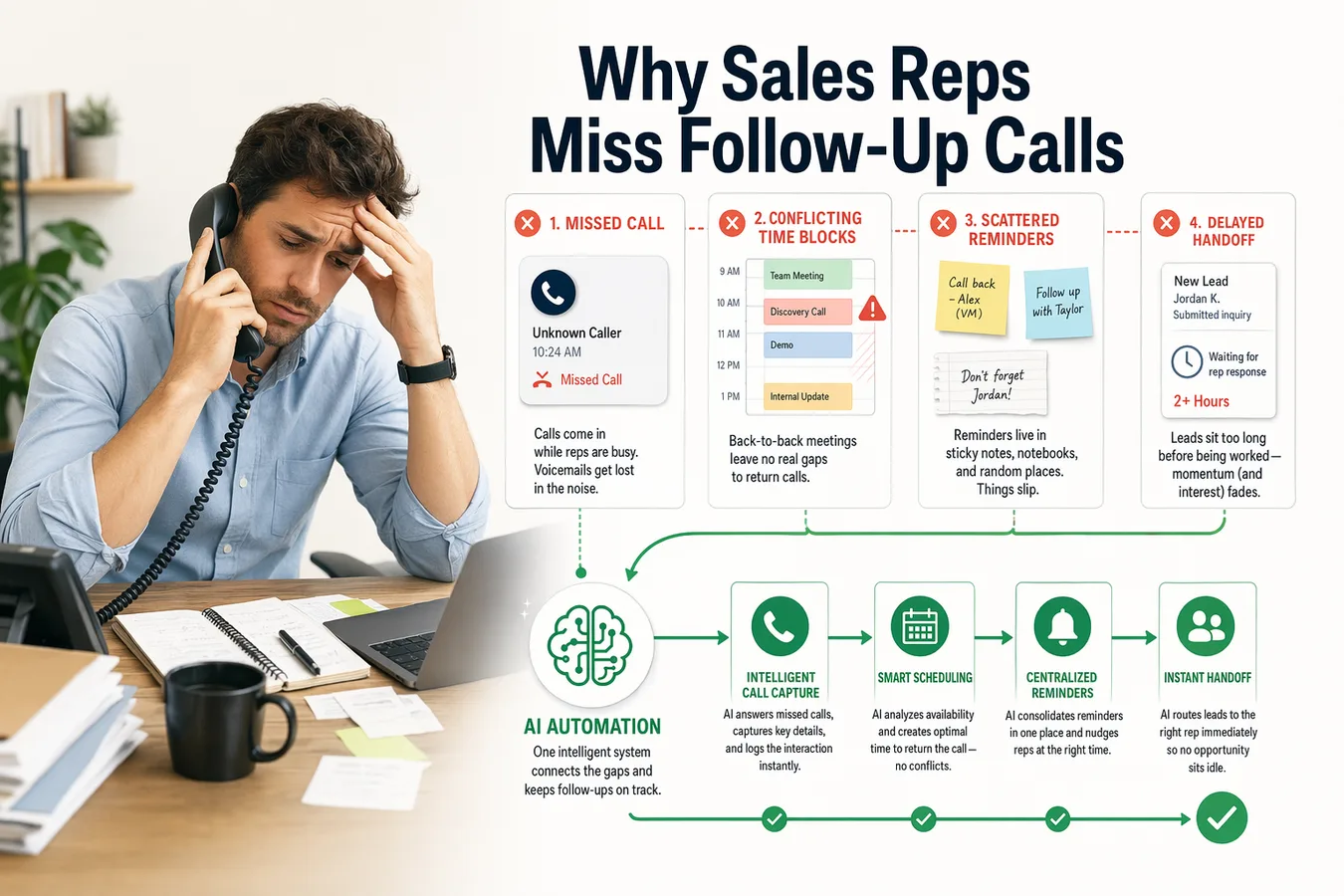
Sales reps miss follow-up calls not because they lack discipline, but because the underlying workflow design makes consistent follow-up operationally impossible at scale.
This article diagnoses four systemic workflow failures that cause the follow-up gap and shows how AI-powered automation eliminates each root cause.
Key Takeaways
48% of salespeople never follow up, and 44% quit after one attempt—despite 80% of sales requiring five follow-up calls.
Four structural failures cause missed follow-ups: manual task overload, CRM disconnects, missing automated triggers, and manager visibility gaps.
Manual dialing and context switching consume hours of rep productivity while creating single points of failure at every step.
AI voice platforms fix all four root causes through autonomous calling, real-time CRM sync, and intelligent escalation logic.
Compliance-ready automation requires TCPA adherence, do-not-call integration, and human escalation thresholds built into the workflow.
Why Sales Reps Miss Follow-Up Calls: The Real Causes Behind the Problem
Sales reps miss follow-up calls not because of poor discipline but because the underlying workflow makes consistent follow-up operationally unsustainable. Every additional touch requires recreating context, re-researching the account, and rebuilding a reason to reach out — friction that compounds with each cycle until starting fresh feels easier than persisting.

The Follow-Up Attrition Pattern: Industry Benchmarks
Research reveals a systematic gap between required and actual follow-up persistence. While [80% of sales require five follow-up calls][1] after initial contact, [48% of salespeople never make a single follow-up attempt][1], and [44% give up after one touch][1]. The attrition accelerates from there: only 10% of reps make more than three attempts, yet this minority captures the majority of conversions. Meanwhile, [60% of customers say no four times before accepting][2], and [70% of marketing-generated leads fall into follow-up black holes][3] across 461 sales reps studied at four firms. The commercial impact is staggering: companies waste [71% of Internet leads][4] due to delayed or missing follow-ups, with average response times stretching to [46 hours and 53 minutes][4].
Systemic Workflow Failure vs. Rep Discipline
The root cause is structural, not behavioral. Traditional sales systems treat follow-up as a manual, rep-driven task rather than a systematized workflow. Each follow-up touch demands manual research, CRM archaeology, and context reconstruction — work that takes longer than prospecting a net-new lead. This article diagnoses the workflow architecture layer that competitors overlook when they prescribe more coaching or persistence training without addressing why consistent follow-up is operationally impossible at scale.
The first structural failure is the cognitive and operational burden that manual follow-up places on individual reps.
Root Cause 1: Manual Task Overload and Context Switching
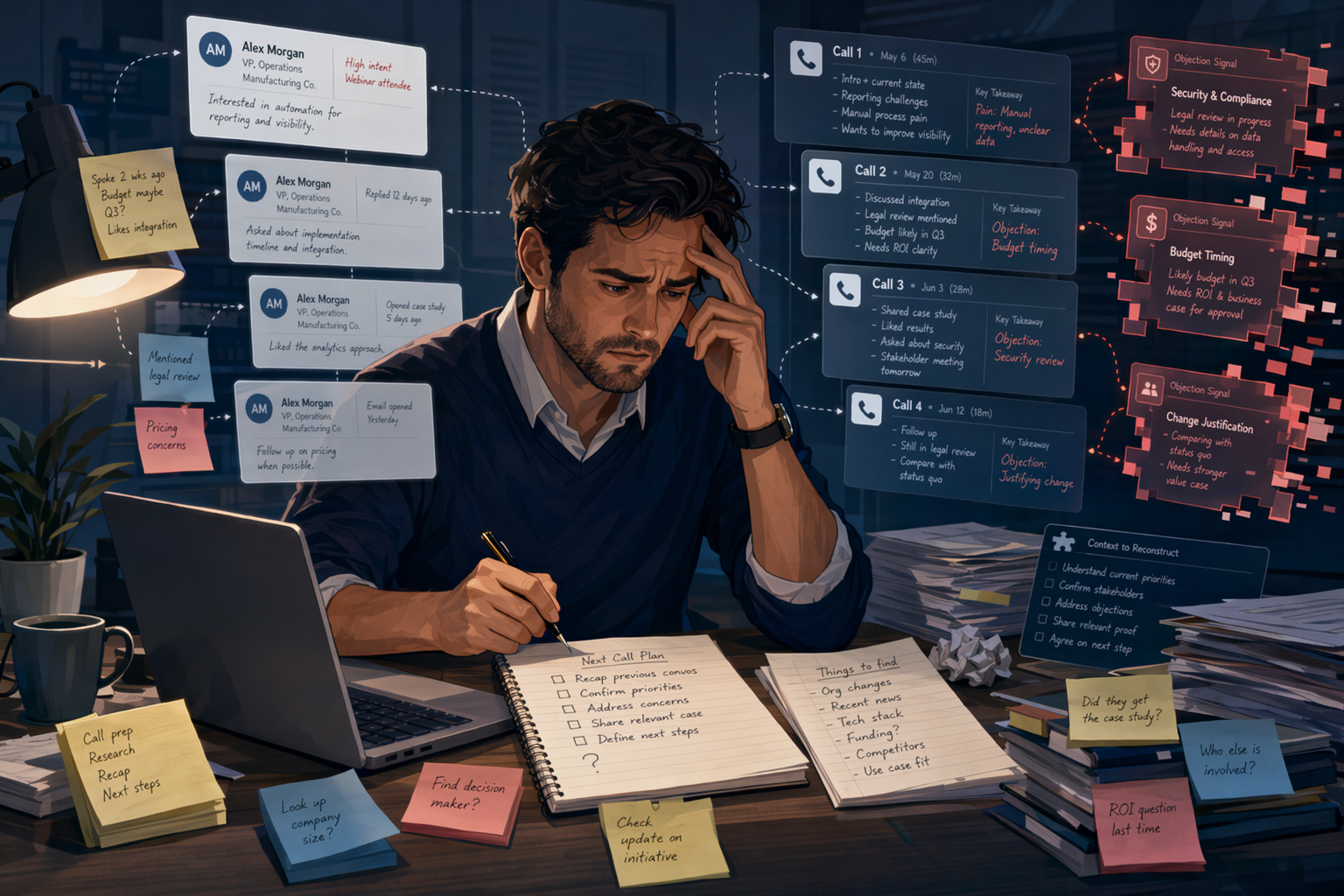
Research Fatigue and Context Loss Between Touches
Sales reps lose conversation context when manually tracking follow-ups across multiple leads, creating a research burden that compounds with every touch. The typical sales cycle demands persistence: only 2% of sales happen on the first contact [5] [5], the chances increase to 3% on the second try [5] [5], and 5% by the third contact [5] [5]. Each subsequent touch requires reps to manually reconstruct the previous conversation's pain points, objections, and buying signals — an unsustainable workflow at scale. When reps juggle dozens of leads simultaneously, they resort to generic scripting or skip follow-ups entirely because reconstructing context for every call consumes more time than the call itself.
Manual Dialing as a Productivity Drain
Manual dialing reduces rep productivity by consuming hours that could be spent on qualified conversations. When some leads can cost upwards of $50, $240 apiece [6] [6], the opportunity cost of manual tasks becomes measurable: time spent looking up phone numbers, navigating CRM screens, and logging call outcomes is time not spent qualifying high-intent prospects. Reps who must manually dial through a list of 50 leads per day spend a substantial portion of their workday on mechanical tasks rather than relationship-building dialogue, amplifying the context-switching burden described above.
Even when reps commit to following up, the second failure surfaces: outcome data captured in one system never triggers actions in another.
Root Cause 2: CRM Disconnects and Missing Call Triggers
CRM Systems Disconnected from Calling Workflows
When call outcomes exist only in voicemail transcripts, scribbled notes, or rep memory, the CRM becomes a passive ledger rather than an active workflow engine. Manual data entry creates lag between the moment a prospect says "call me next week" and the moment that directive reaches the system that schedules the callback. This delay breaks trigger logic: the CRM doesn't know what happened in real time, so it can't fire the next-step automation.
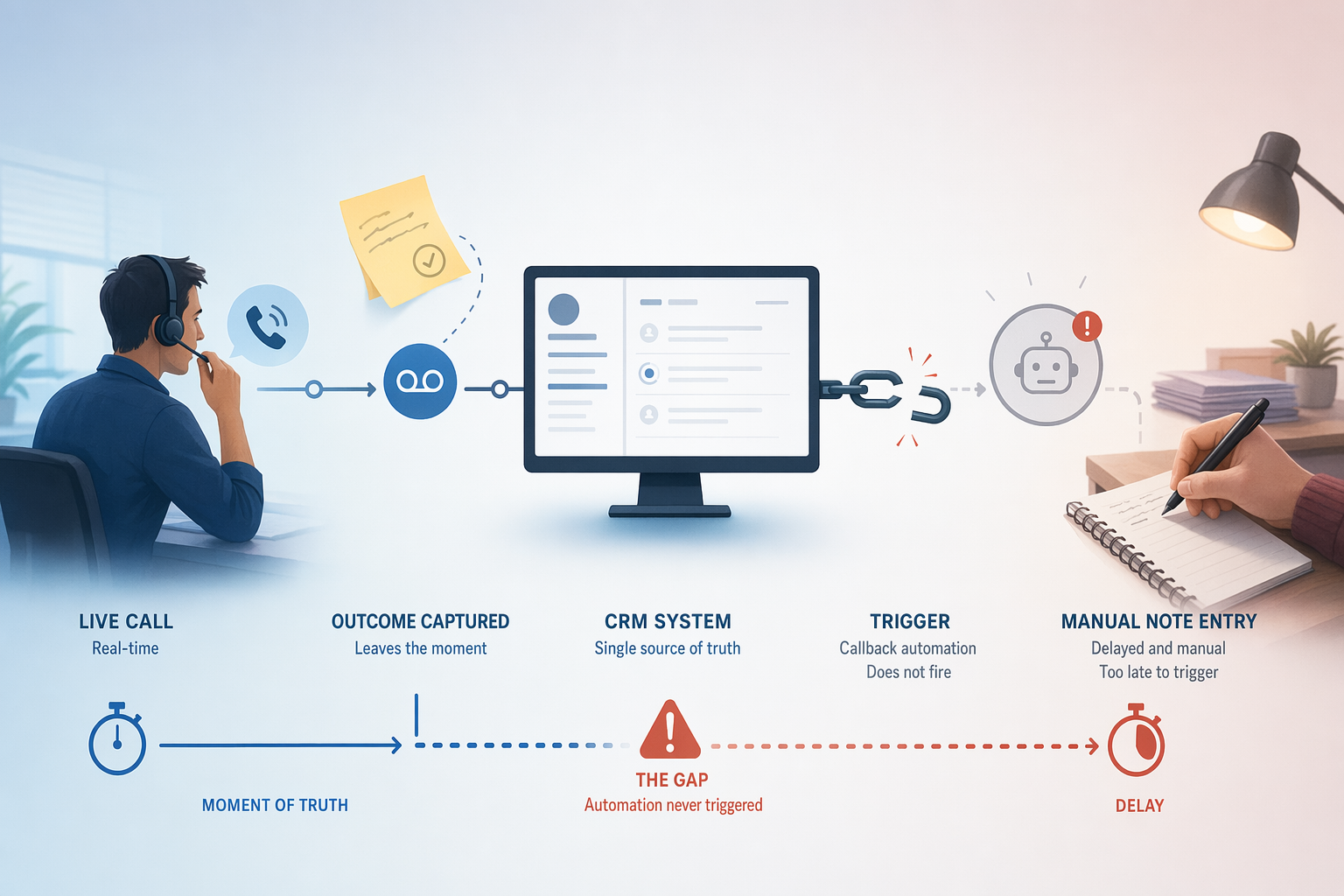
Platforms that integrate APIs and webhooks eliminate this lag by capturing data directly into CRM platforms [7] during or immediately after the call. Bi-directional sync ensures that call outcomes, qualified lead, objection recorded, meeting booked, flow into the CRM before the rep moves to the next prospect. When calling workflows and CRM systems operate as one connected layer, trigger logic remains intact.
No Automated Triggers Based on Call Outcomes
Without outcome-based automation, follow-up cadence relies on rep memory and manual calendar coordination. A voicemail should trigger a retry in 2 hours; an interested prospect should auto-schedule a demo; a hard "not interested" should pause the sequence. When these rules live in a rep's mental model rather than in the CRM's workflow engine, execution becomes inconsistent.
Sales automation platforms that sync call results directly into CRM systems enable trigger-based workflows: voicemail → retry in 2 hours, objection → send case study email, interested → book meeting with calendar integration. EchoLeads, for example, provides bi-directional CRM sync so that every conversation outcome updates the CRM before the next call begins, allowing the system to execute the next step without human coordination. For broader context on how disconnected workflows degrade conversion, see our guide on why outbound calls fail to convert leads.
Beyond data capture, the third gap is the absence of automated logic that schedules the next touch based on what happened in the last one.
Root Cause 3: No Structured Follow-Up Cadence or Workflow
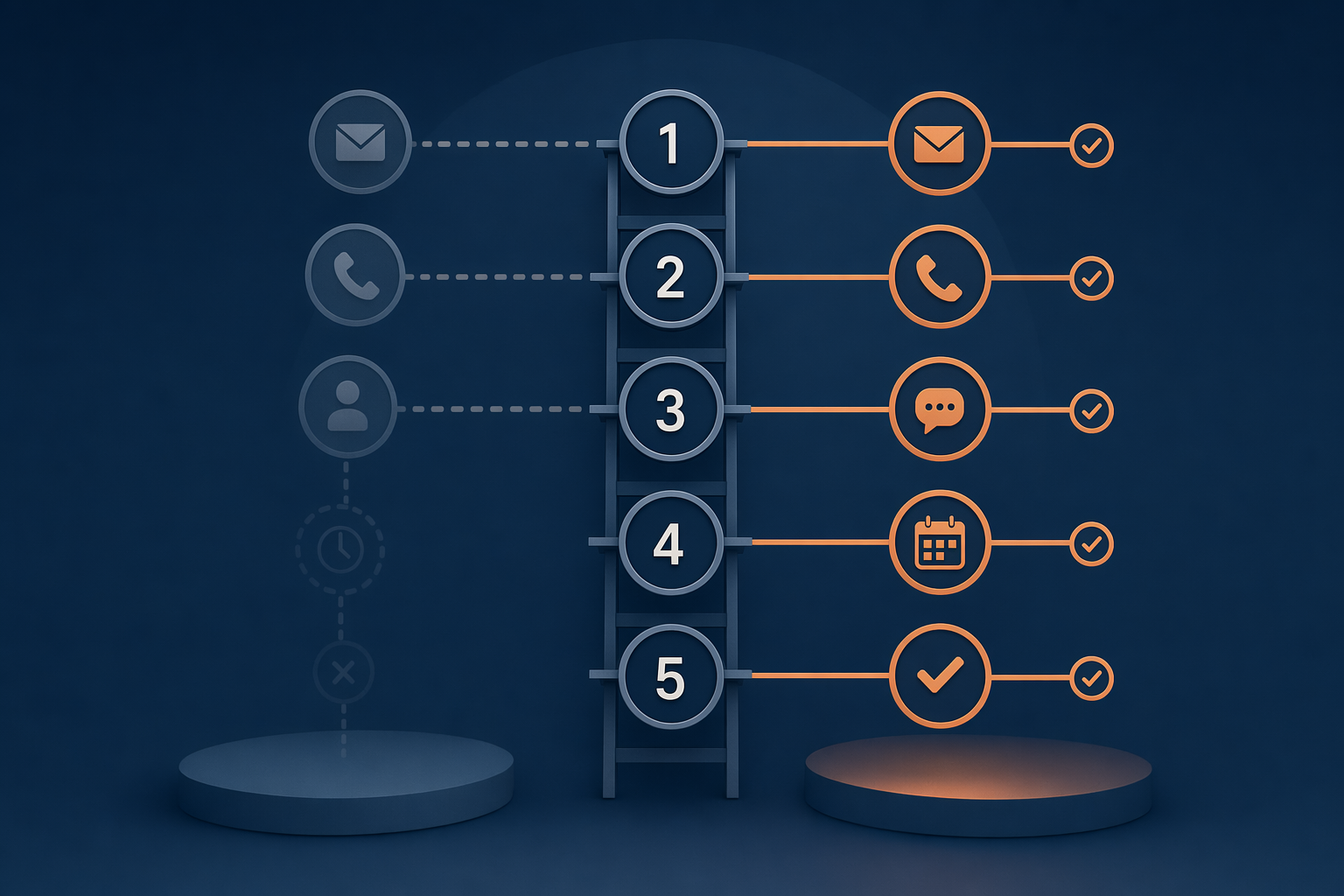
The third structural failure is the absence of automated cadence logic. When follow-up timing and sequence are left to individual rep discretion, most reps stop too soon: 44% of sales reps stop following up after one attempt, yet 80% of sales require at least five follow-ups. This is not a discipline problem, it is a workflow design problem. Manual coordination introduces failure at every step.
Manual Cadence Coordination vs. Autonomous Scheduling
Manual cadence coordination requires the rep to:
Manually schedule the next follow-up in their calendar (risk: forgotten or overridden by other tasks)
Manually retrieve lead context before the call (risk: incomplete or outdated notes)
Manually log the outcome after the call (risk: delayed or missing CRM updates)
Manually schedule the next step based on outcome (risk: incorrect timing or no follow-up at all)
Each step is a single point of failure. Autonomous scheduling eliminates manual coordination by encoding cadence logic directly into the workflow: voicemail → 2-hour retry, interested → book meeting, not interested → 1-week nurture. EchoLeads implements this through scheduled voice and messaging-based follow-ups across multi-day and week timelines, removing the coordination burden from the rep entirely.
The Difference Between Discipline and Systemic Automation
Sales managers often treat the 44% one-attempt failure rate as a training issue, coaching reps to "be more persistent." But individual behavior cannot fix a structural problem. Reliable follow-up at scale requires systemic automation: the workflow must schedule the next touch based on outcome, not rely on the rep to remember. Discipline is unreliable when applied to 50 leads per rep per week. Automation is reliable by default, the cadence executes whether the rep remembers or not.
When manual execution, disconnected systems, and missing automation combine, the fourth failure emerges: managers lose real-time visibility into pipeline health.
Root Cause 4: Visibility Gaps for Sales Managers
No Real-Time Follow-Up Tracking
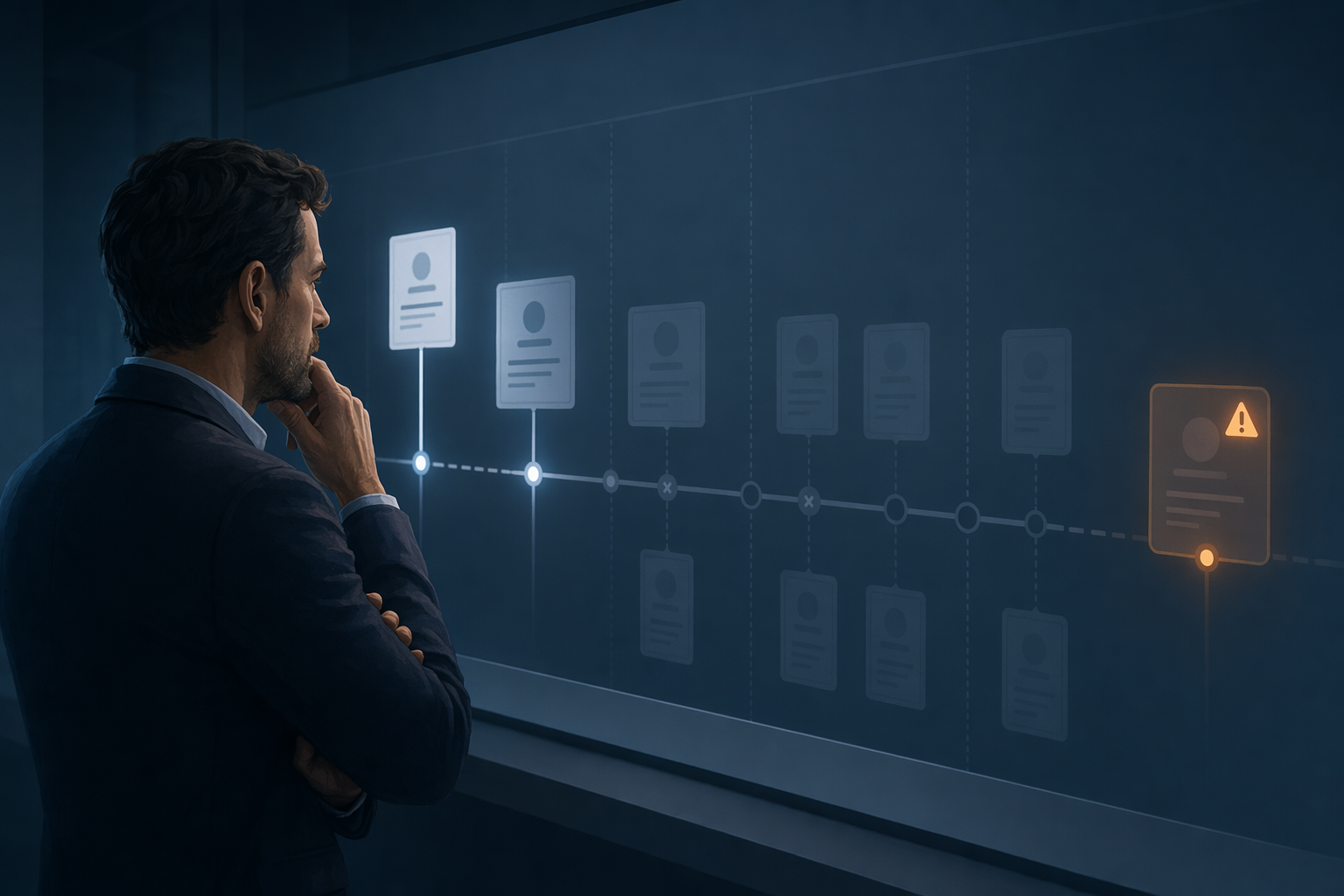
When follow-up tracking relies on manual rep updates, end-of-day summaries, weekly pipeline reviews, managers cannot course-correct in real time. Manual task overload means reps don't log outcomes promptly; CRM disconnects leave outcome data stale; without automated cadence, follow-up status remains invisible until deals are lost. By the time a manager sees the pipeline report, high-value prospects have already gone cold.
The Cost of Delayed Course Correction
Research shows that companies lose an average of 12% of annual revenue [9] due to poor sales practices, £1.2 million for every £10 million in revenue [9]. The primary culprit: lost track of prospects, missed follow-ups, and zero visibility [9] into the sales pipeline. Without real-time tracking, managers discover pipeline problems weeks after intervention could have salvaged the deal.
AI-powered automation platforms address these four root causes by collapsing calling, CRM sync, and workflow logic into a single closed loop.
How AI-Powered Automation Fixes Follow-Up Failures
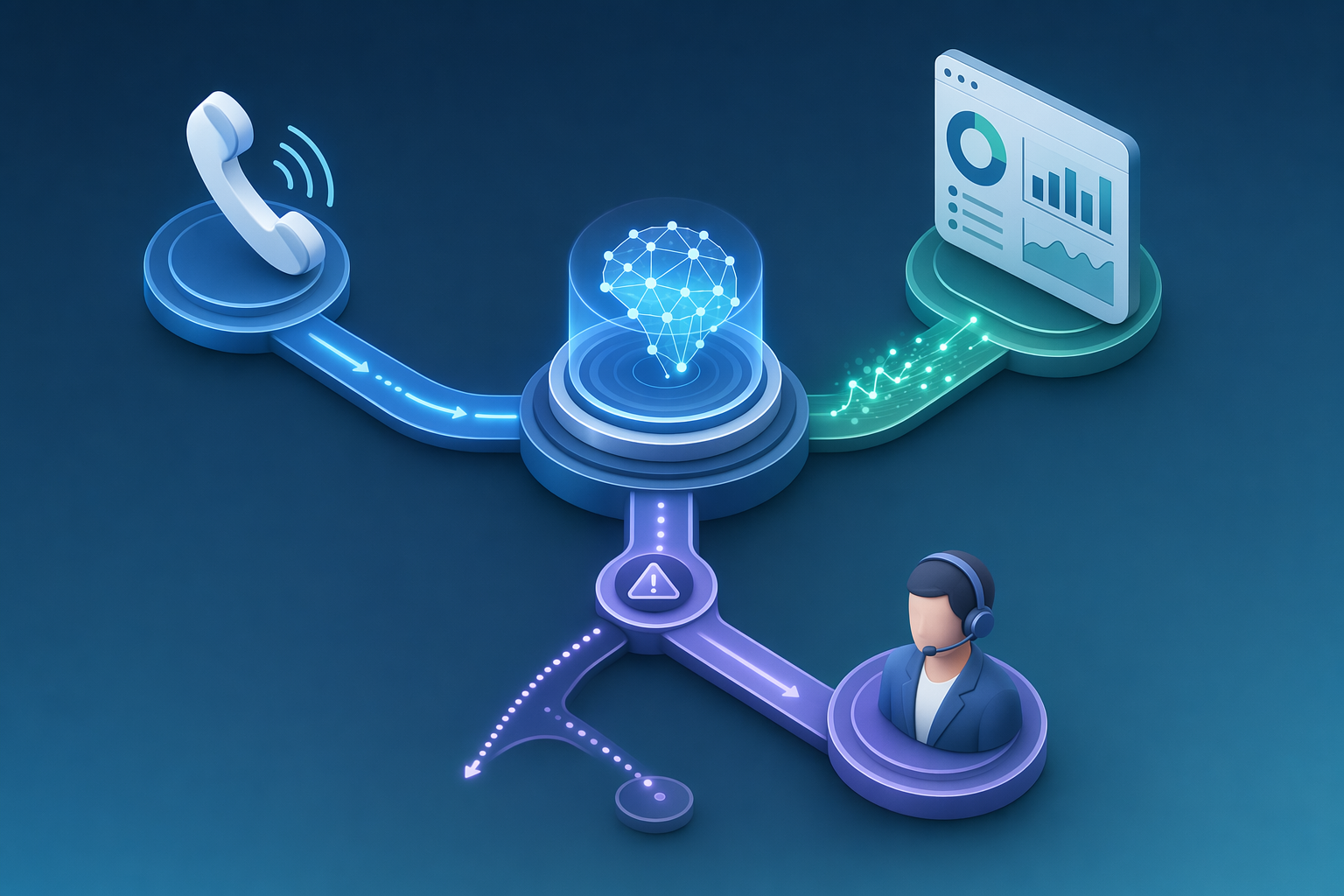
AI voice platforms address all four root causes through three structural changes: autonomous calling that removes manual execution, real-time CRM sync that closes data gaps, and intelligent escalation logic that routes complex conversations to human reps when necessary.
Autonomous Calling and Multi-Session Context Retention
AI voice agents preserve conversation context across multiple follow-up sessions, eliminating the manual research fatigue that causes reps to skip callbacks. Instead of reconstructing prospect history from CRM notes before each call, the system retains prior exchanges and dynamically adjusts its next response based on earlier touchpoints. Platforms like EchoLeads operate 24/7, initiating contact within seconds and responding with sub-1s latency in 50+ languages, meeting the instant-response expectations that fix Root Cause 1's speed-to-lead failures.
CRM Sync and Outcome-Based Triggers
Bi-directional CRM integration fixes Root Cause 2 by capturing call outcomes in real time and enabling automated triggers, voicemail prompts retry, interested signals book meetings, disqualifications pause sequences. EchoLeads syncs every conversation outcome to Salesforce, HubSpot, Pipedrive, or Zoho before the next call begins, eliminating the manual logging step that creates data gaps. Outcome-based workflows replace static cadences: the system detects buying signals and adjusts follow-up timing without human intervention, addressing Root Cause 3's cadence-automation failures.
Human Escalation Logic and Compliance Requirements
AI platforms are not legal without regulatory adherence: TCPA and DNC requirements are operationalized through do-not-call list integration and consent verification before automated calling. EchoLeads uses intelligent escalation logic that transfers conversations to human agents when complexity, sentiment, or compliance risk exceeds safe autonomy thresholds, ensuring high-intent or sensitive conversations receive human attention. Learn more about AI SDR solutions and multi-channel support for platform-selection context.
What to Look for in a Sales Automation Platform
A platform's ability to prevent follow-up gaps depends on four measurable criteria, the Follow-Up Automation Readiness Index:
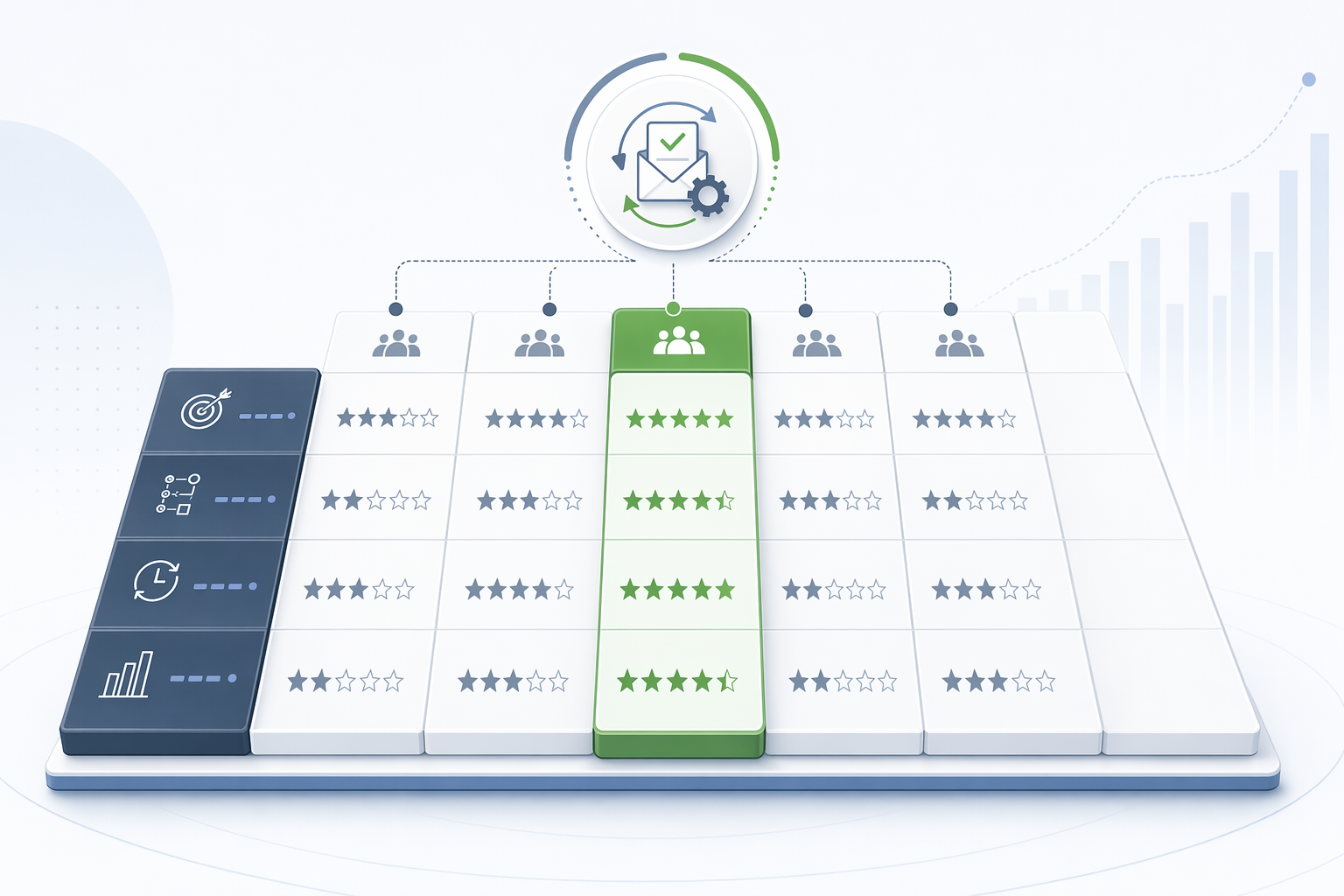
Speed to first response, Industry average stands at 46 hours 53 minutes; automation should deliver sub-2-second contact initiation after form submission or ad interaction.
Touch persistence, Minimum 5 follow-up attempts; top-performing systems sustain 6 to 12 contacts before retiring a lead. Cold-call connect rates climb from 2 to 3% on first contact to 5 to 8% for teams that persist through multiple touches [12].
CRM continuity, Direct API or webhook capture into your CRM, eliminating manual re-entry and preserving qualification data across all touchpoints.
Context retention, Conversation history travels with the lead across sessions, so follow-up #7 recalls what was said in follow-up #3.
Platform Comparison: Pricing and Free Trial Availability
Six platforms illustrate the automation-readiness spectrum:
Platform | Starting price | Free trial / free plan |
|---|---|---|
EchoLeads | ₹14,999/month | Yes (14-day trial) |
GoDial | ₹799/user/month | Yes (14-day trial) |
Freshsales | ₹999/user/month | Yes (21-day trial + free plan) |
LeadSquared | Contact for pricing | Yes (15-day trial) |
Zoho CRM | ₹800/user/month | Yes (15-day trial + free plan) |
Kylas CRM | ₹8,000/month (10 users) | Yes (15-day trial) |
EchoLeads supports response-speed automation through instant response workflows and CRM-connected automation that address criteria 1 and 3 of the index. For detailed feature breakdowns, explore the EchoLeads platform page.
Conclusion
Custom API integrations suit teams with engineering resources to build CRM pipelines from scratch, but they require ongoing developer maintenance. EchoLeads suits sales teams who need autonomous follow-up without engineering dependencies, single-platform tracking works for teams with one CRM and one calling tool, but unified visibility across calling, CRM sync, and real-time dashboards requires a more integrated approach.
As AI voice platforms mature, the competitive advantage will shift from who follows up fastest to who preserves context best, multi-session conversation retention will become the new baseline expectation for sales automation, separating platforms that simply dial from those that truly remember.
Explore EchoLeads's AI platform to see how autonomous calling and bi-directional CRM sync eliminate manual follow-up failures. The four root causes diagnosed in this article, task overload, CRM disconnects, missing triggers, and visibility gaps, are addressable today through intelligent escalation and outcome-based automation.
Frequently Asked Questions
Why do sales reps stop following up after one or two attempts?
Reps stop following up because the workflow is structurally broken, manual task overload, no automated triggers, and CRM disconnects create friction at every step. [48% of salespeople never follow up][1], and [44% quit after one attempt][2], not from laziness but from systemic failure.
How many follow-up calls does it typically take to close a sale?
[80% of sales require five follow-up calls][1] after initial contact, and [80% occur between the fifth and twelfth touches][1]. Yet the industry average is just 1.3 attempts [4], revealing a massive persistence gap driven by workflow design, not rep behavior.
Can AI voice agents handle follow-up calls autonomously, or do they require human oversight?
AI platforms handle routine follow-up autonomously 24/7, preserving conversation context across sessions [10][11]. Human oversight is built-in through confidence thresholds: high-intent or sensitive conversations trigger intelligent escalation to human reps, ensuring quality control without manual coordination overhead.
What compliance requirements apply to automated follow-up calling?
Automated calling must comply with TCPA and DNC regulations: platforms must verify consent and integrate do-not-call lists before dialing [10][11]. AI systems are not legally deployable without these safeguards, compliance is operationalized through pre-dial checks and consent verification workflows.
How does AI preserve conversation context across multiple follow-up sessions?
AI voice agents maintain a persistent conversation history, enabling them to resume discussions naturally without requiring leads to repeat information [10][11]. Unlike manual reps who reconstruct context from CRM notes, AI systems retain full conversational state across sessions, eliminating research fatigue.
What's the difference between fixing follow-up discipline and fixing follow-up workflow?
Discipline coaching addresses individual behavior; workflow fixes address systemic design. [44% of reps quit after one attempt][8] not because they lack persistence but because manual coordination, remembering outcomes, scheduling next touches, updating CRMs, creates failure points that individual effort cannot overcome at scale.
How do I know if my CRM is disconnected from my calling workflow?
Three diagnostic signals reveal CRM disconnect: reps manually log call outcomes after the fact, follow-up reminders are calendar-based instead of outcome-triggered, and managers review pipeline health in weekly meetings rather than real-time dashboards [9]. If all three apply, your CRM is passive, not operational.
Related articles
How to Increase Sales Team Capacity Without Hiring More Reps (2026)
Learn how AI voice automation expands lead-handling capacity without hiring.
Automated Lead Qualification Software Over the Phone: Setup Guide (2026)
AI voice agents qualify leads over the phone autonomously.
Outbound Sales Calls Low Conversion Rate: 4 Operational Bottlenecks and How AI Voice Automation Fixes Them
Outbound sales calls take too long and barely convert.